I have written more in the past week than I have in a very long time (excluding writing papers because let’s be honest, this is far more fun). It’s been slightly hectic given that I spent half of this past week in Florida, but having the writing notebook has motivated me to take time every day and reflect on something that happened in my day. Never have I found a more rewarding school assignment, one that I believe that I will continue with far past the boundaries of this class. When reading “Mentor Texts”, one note stood out to me more than anything else. It states:
As students get older, writer’s notebooks become their treasure chests. They write about their observations, anecdotes, connections to literature, and discoveries about authors’ craft. They write the tiny stories that they record of the history of their lives
Dorfman & Cappelli, Chapter 2, Page 23
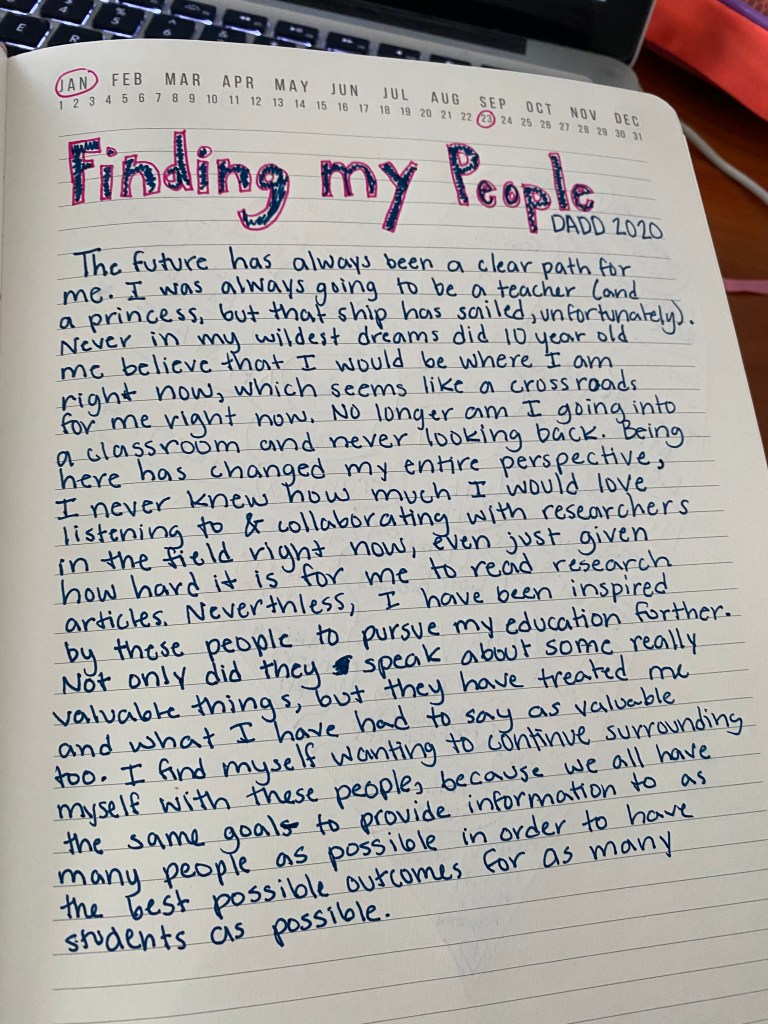
That got me thinking a lot about not only the students I want to teach, but also myself. I can sometimes struggle with my memory, and having something that I can go back to that allows me to think back to what happened in a particular moment or on a particular day is really special. I want to teach student with significant disabilities, so giving them a space where they can reflect on what is going on in their lives is also really important. Some of these students don’t always have a way to have a ton of different traditionally “exciting” experiences, for medical or other reasons. Using the writers’ notebook as a catalyst for them to write about what is important to them and as something I can use to introduce them to new things and learning experiences is exciting. I look forward to implementing a writers’ notebook in my classroom in the future, so I can help my student’s to celebrate what happens in their lives, as well as to react to thing that they have learned. At the end of the year, it will be so rewarding when they can go back into their notebooks and see all that they have accomplished and experienced.
Kind of building off my previous thoughts, I’ve been thinking about ways that I can adapt a writers notebook experience for my children with significant disabilities. I’ve thought about having students keep an online journal filled with pictures of what they feel is important to them. In an ideal world, I would love to have each student have access to a camera or someone with a camera that they can instruct to take pictures of something to add to their notebook. Writing can be a tiring task for many with physical disabilities, so allowing them to gather these pictures of what they find important for them to come back to and write about later is a really neat idea. I can also open that up to parents to upload pictures of things that they have done on vacation, over a weekend, etc. so that the child has an abundance of different topics that they can write about, as well as a “memory book” of sorts that they can look back on in the future.
“Textbook Amy Krouse Rosenthal” continues to leave me struggling for breath from laughing so much. In particular, her “Resolutions of Bewilderments” (pg. 88) were so relatable and really made me pause to think about all of the different things that I have realized as I’ve gotten older. From little thing like why my parents didn’t let me bake cookies as much as I would have wanted to (I was a pretty messy kid and it might have been disastrous) to why TV’s were in black and white back when my parents were kids (I was 8 or 9 before I realized that it wasn’t because the world was black and white back then). Those are things that we never really think about, but those little bewilderments happen constantly. They have really inspired me to think more deeply on all of those “life” things that I’ve learned and are topics that I think would make great writers’ notebook topics in the future.
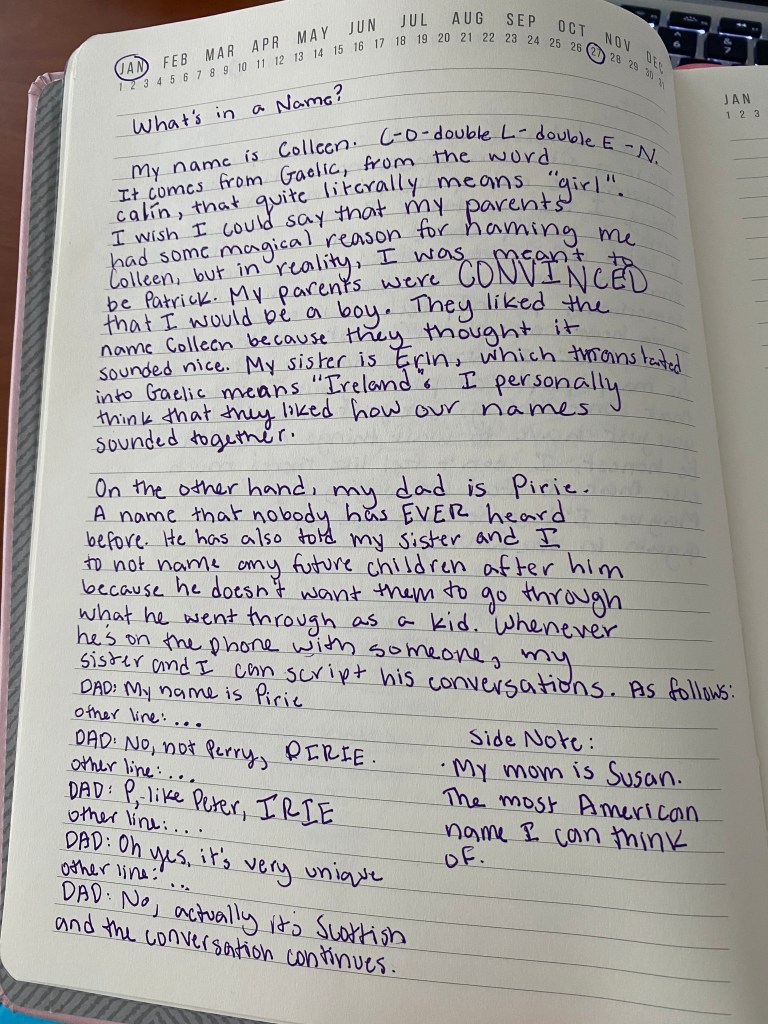
In “Brown Girl Dreaming”, I really connected with a few different moments within the book. One of the poems that stood out to me was, of course, the poem she wrote about her name, “A Girl Named Jack” (p. 6-7). As somebody with a unique name, and as someone who was “supposed” to be a boy, I felt Woodson’s words deep in my soul. As my journal entry below states, “I was an “almost” Patrick.” I’ll admit, I am incredibly grateful to not be a “Patty” or something along those lines. See my “What’s in A Name?” notebook entry below:
Towards the end of the book, she writes an “I Believe” poem, which I distinctly remember writing in either middle school or my freshman year in high school. Or maybe I have written more than one, I’m not entirely sure. It was really cool to see a familiar poem format and to see how she made it her own. In general, I think any way that we state our beliefs is extremely powerful, and the way she does it in her book is no different. Stylistically, I loved her choice to not start her poems with capital letters and only capitalizing proper nouns. Using the capitals as a way to create emphasis was really powerful to me.
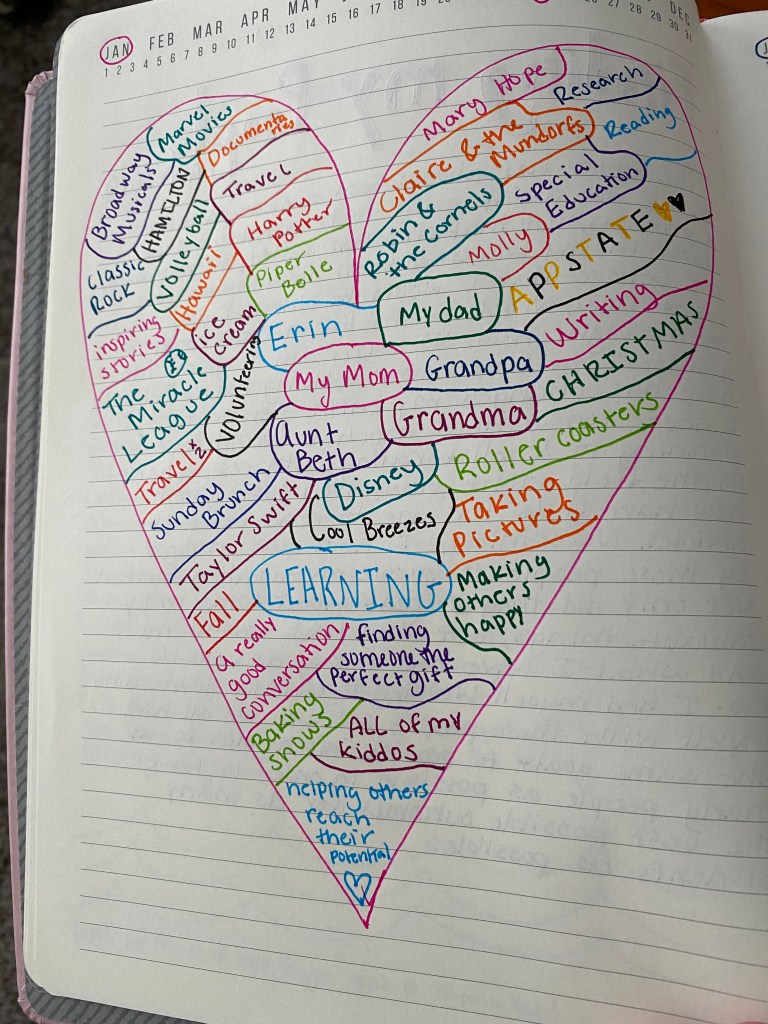
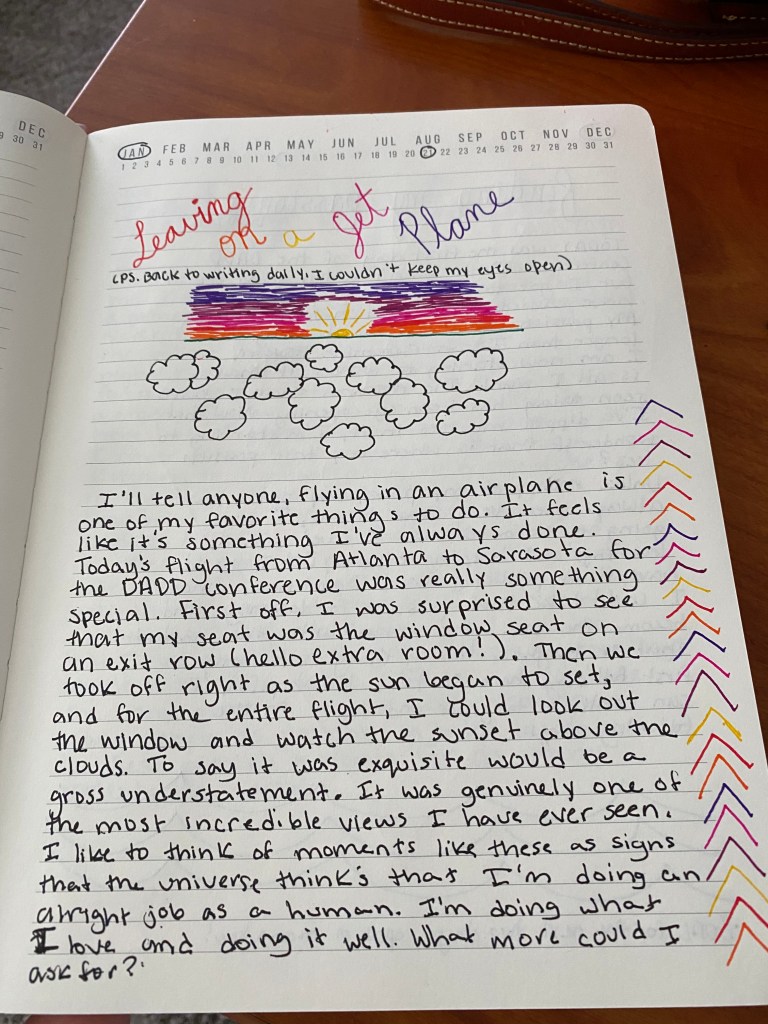
I have also included a few of my other favorite notebook entires so far, including my heart map, which I actually have another version of in a notebook that I have from the second grade. How wild is that? I don’t remember exactly where that notebook is, but I distinctly remember creating a heart map for Ms. Jacob’s class. Some of the contents have changed, but many have stayed the same, from my family to things like Disney and Harry Potter.
Dorfman, L. R., Cappelli, R., & Hoyt, L. (2017). Mentor texts: teaching writing through childrens literature, k-6(Vol. 2). Portland, ME: Stenhouse Publishers.
Woodson, J. (2014). Brown girl dreaming. New York: Puffin Books.
Rosenthal, A. K. (2016). Textbook Amy Krouse Rosenthal. Penguin Group USA.
 Ms. Colleen's Writing Site