When students are first starting on writing in a writer’s notebook, one of the biggest struggles that they face is finding what they are supposed to write about. As teachers, we don’t want to tell students what to write, but we do need to give students the tools that they need to choose their own topics and to motivate them to write. I decided that I would try one of those strategies myself, as shown below. In “Mentor Texts”, Dorfman & Cappelli discussed writing territories and how to narrow those territories down into specific topics. Territories can be people, activities, prompts, pets, and so many other things. Anything you can write a lot about can become a territory. Once you pick a territory, it’s important to narrow that down to a specific topics. One strategy that is modeled in “Mentor Texts” is using an upside down triangle to help the students narrow in on a singular topic. When I wrote mine, I decided the territory I wanted to write about was Claire, a girl that I care for at home. As I narrowed my topic down, I wanted to focus on when I get to come home and surprise her because that is always an exciting time for us. In particular, whenever I surprise her, she demands my attention and that we read together. Those memories are really special to me, so I knew that I wanted to write about that in my notebook.
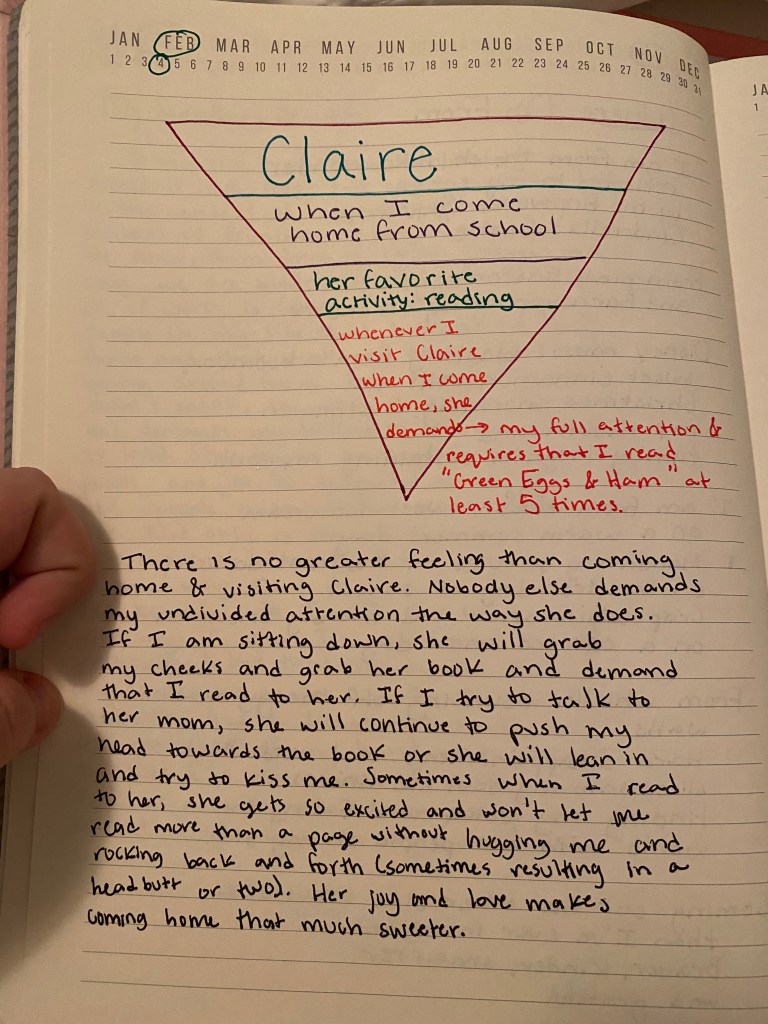
In the piece “Launching the Writer’s Notebook” from Calkins, she describes a very similar strategy , describing how she had her students pick important people in their lives, have them write down a few memories of that person and then having them pick a memory to write about. In the article, she shows us how she modeled it for her students. I found that this was just a different way to structure what Dorfman & Cappelli described in Mentor Texts. The way that they use the strategy is in a more visual way than how Calkins by using that graphic organizer. I really like the upside down triangle because you can visually see how you are narrowing down what you’re going to write about. I can see something like that being used in my future classroom quite easily. Anything I can use to support writing in a visual way is going to be valuable to students with more significant needs.
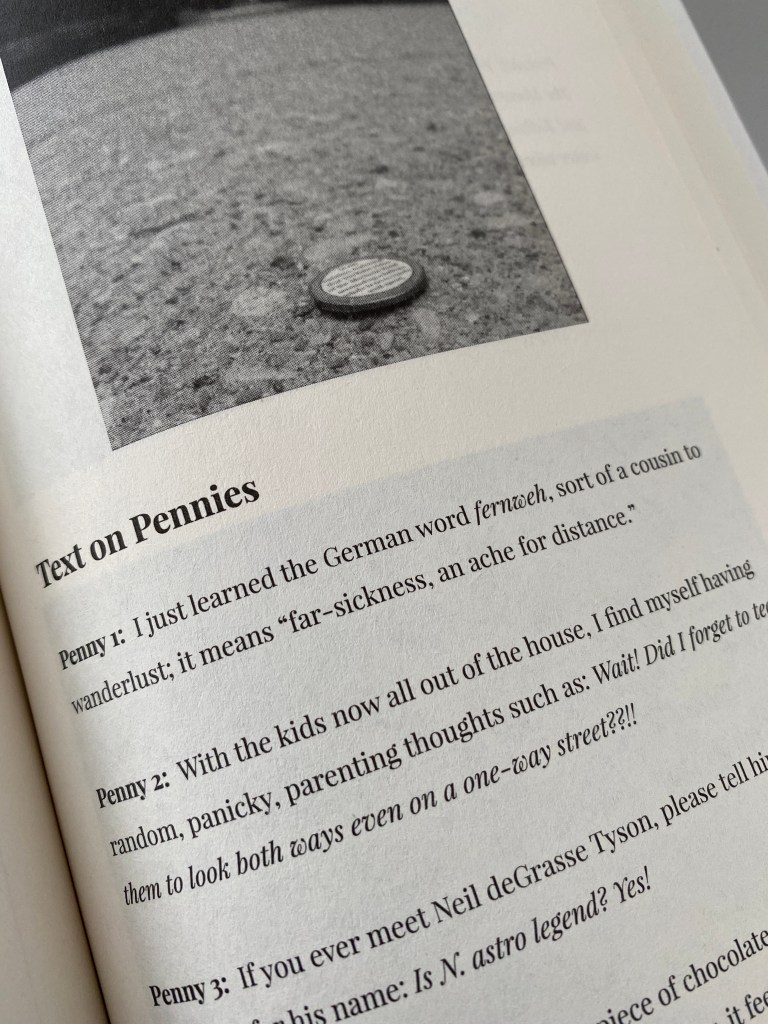
In addition to learning how to help students generate ideas for their writing, we also took a look at a few different “mentor” texts in the forms of “Textbook Amy Krouse Rosenthal” and “Brown Girl Dreaming”. In “Brown Girl Dreaming”, I found a few poems that I thought would really lend themselves to being mentor texts for students. One in particular called “what god knows” could really inspire some introspection and really thoughtful writing. Of all the poems in “Brown Girls Dreaming”, this one really made me pause and think about what I believe and how that relates to what other people believe. For older students, middle schoolers in particular, discovering who they are in relation to the people around them and I know when I was that age, I was really motivated to write about what I believed in and what that meant to me. I look forward to exploring that further even as a 23 year old in my writer’s notebook.
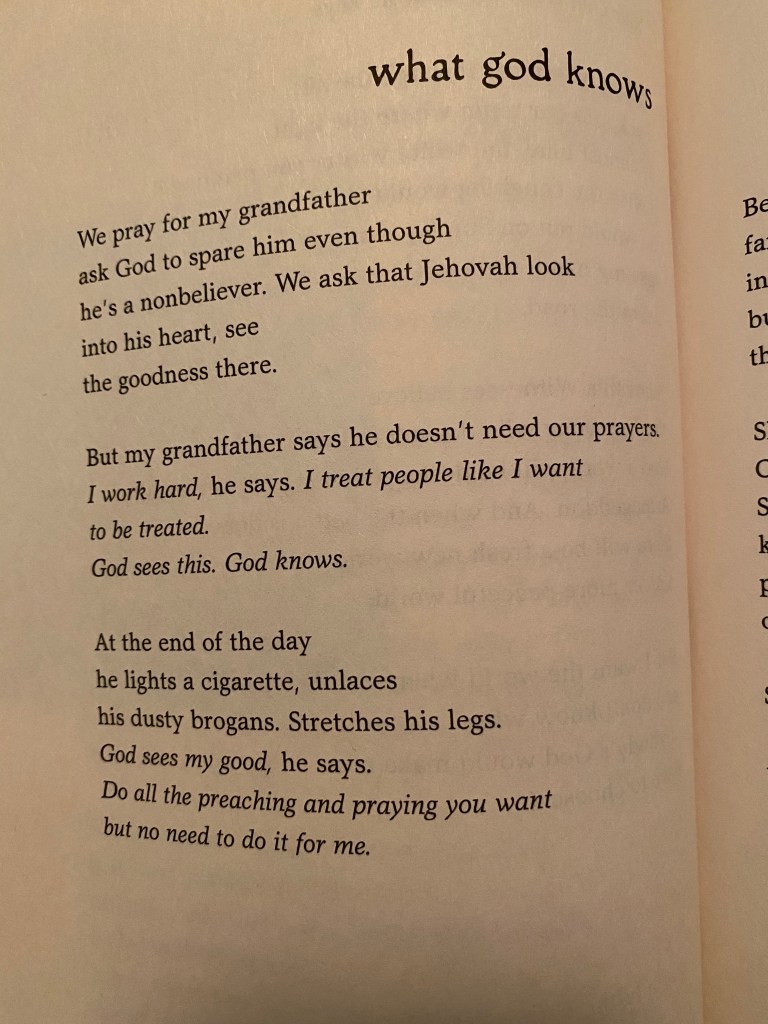
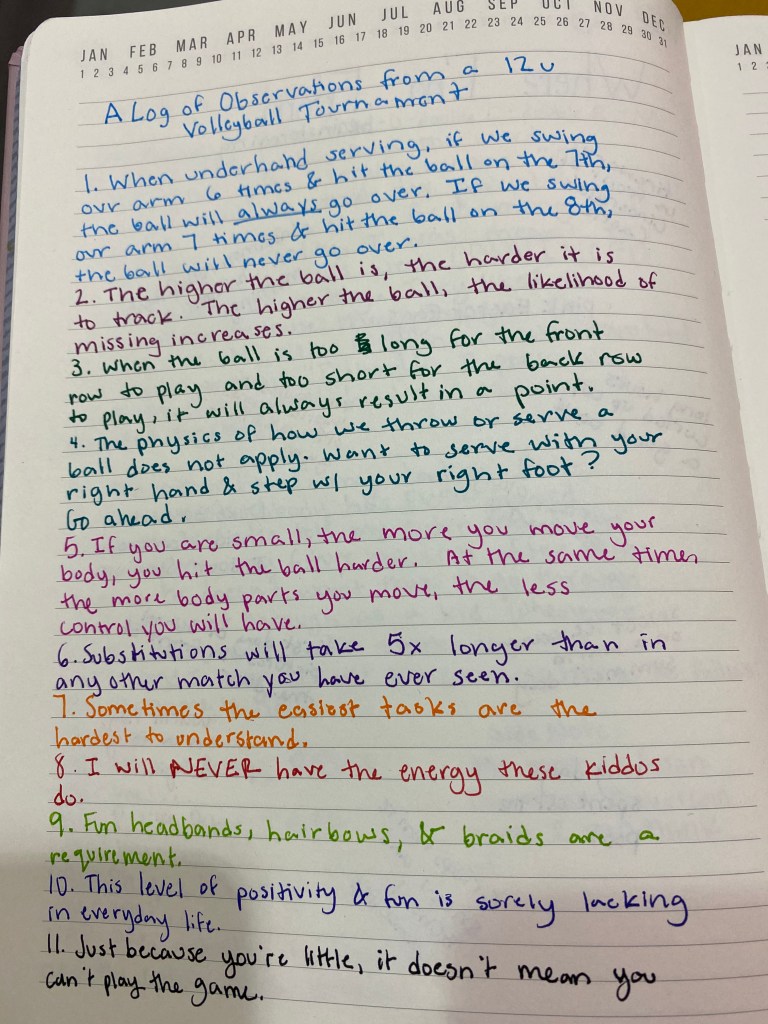
I swear, “Textbook Amy Krouse Rosenthal” is becoming one of my favorite books. In particular, her “A penny for your thoughts” exercise was particularly inspiring. I love writing down observations and thoughts that I have, as evidenced by one of the entries that I actually wrote before I even looked at TAKR this week. I referee volleyball and working with the 12 and under age group is always particularly entertaining. There ended up being more free time, so I decided that I would take that time to write down observations and lessons that I learned from the players. They did not disappoint to say the least. There were so many funny one-liners and even profound findings that I hadn’t anticipated. I think that keeping track of things that you learn and think about is a good way to remain present, as well as a way for you to remember things that you don’t want to forget.
Introducing students to both mentor texts and strategies that help them to generate ideas of their own are vitally important to create independent writers. Help them find what they’re passionate about, what they want to learn, how to observe the world around them. All of these things can lead to really deep, powerful writing moments, but it’s our job as teachers to help them get to the place where they can do that.
Dorfman, L. R., Cappelli, R., & Hoyt, L. (2017). Mentor texts: teaching writing through childrens literature, k-6(Vol. 2). Portland, ME: Stenhouse Publishers.
Woodson, J. (2014). Brown girl dreaming. New York: Puffin Books.
Rosenthal, A. K. (2016). Textbook Amy Krouse Rosenthal. Penguin Group USA.
Calkins, L. M. (2006). A guide to the writing workshop, grades 3-5. Portsmouth, NH: Heinemann
 Ms. Colleen's Writing Site