Featured

Writing and Serendipity

“What some people call serendipity sometimes is just having your eyes open”

Jose Manuel Barroso

You can always edit a bad page. You can’t edit a blank page.

— Jodie Picoult

Welcome to my writing blog! I previously had a website that discussed children’s books, but I couldn’t edit it enough to get it to look like how I wanted it to, so I started over. This website is for the class “Teaching the Language Arts”, which has a specific focus on writing. The beginning of this class has been a little hectic, as I am currently sitting in a hotel room in Sarasota, FL preparing to attend the national DADD conference. Anyways, here’s my first blog post!

I have begun writing in my writer’s notebook that I purchased at Walmart. My goal for the semester is to try to write something at least 6 out of the 7 days of the week. Writing used to be a passion of mine, but once I entered high school, the writing became far less fun, so I stopped after a while. With this writers notebook, I hope to reignite the enjoyment that I used to get from writing. For my future students, learning to write as a way of self expression is of paramount importance to me. The mechanics and grammar can all be fixed at a later time, as the quote from Jodi Picoult states above. Writing needs to be a safe space for students with and they must feel like the purpose of writing isn’t to be criticized. One paragraph stood out to me from the book “Mentor Texts”:

A student writer is a part of a larger community. He needs to feel safe when he puts his writing out into the world. Clearly, norms must be established that the community honors. Central to “rules to live by” is the idea that a writer is never personally criticized- only the writing, and only in the spirit of moving the writer forward. Student writers must understand that they are not alone and that writing is not a solitary act. Indeed, they must be able to listen attentively and let the thinking of the community be something they consider and learn from. Noticing problem-solving strategies in writing workshop will be the key factor to success and growth in writing.

Lynne R. Dorfman & Rose Cappelli, p 14

Normally, I wouldn’t dream of putting a quote that long into a post, but I feel that every word is vitally important. I think for so many of us, we think of writing of something that we do independently (which we sometimes do, in a journal or a diary), and is something that is only ever criticized. For so many people, writing means more to us than a math test or a science lab paper. Writing is an incredibly personal experience, and that’s why so many people feel personally insulted when somebody comes in and critiques their writing. It can absolutely feel like a personal attack that needs defending. That is why, as stated above, rules need to be set up and followed when editing somebody’s writing, so we can ensure that what we are attempting to fix is only the person’s writing and not an attack on them. This is why writing notebooks exist. You can write whatever you want in a writer’s notebook without fear of it being scrutinized or judged. Having a class work in writer’s notebooks allows them to feel connected to one another and allow them to use those notebooks as a source for positivity and creativity as opposed to something that needs to be constantly corrected. Within the space of a writer’s notebook, the rules that come with more conventional writing activities go out the window and the only person’s whose opinion matters is the writers.

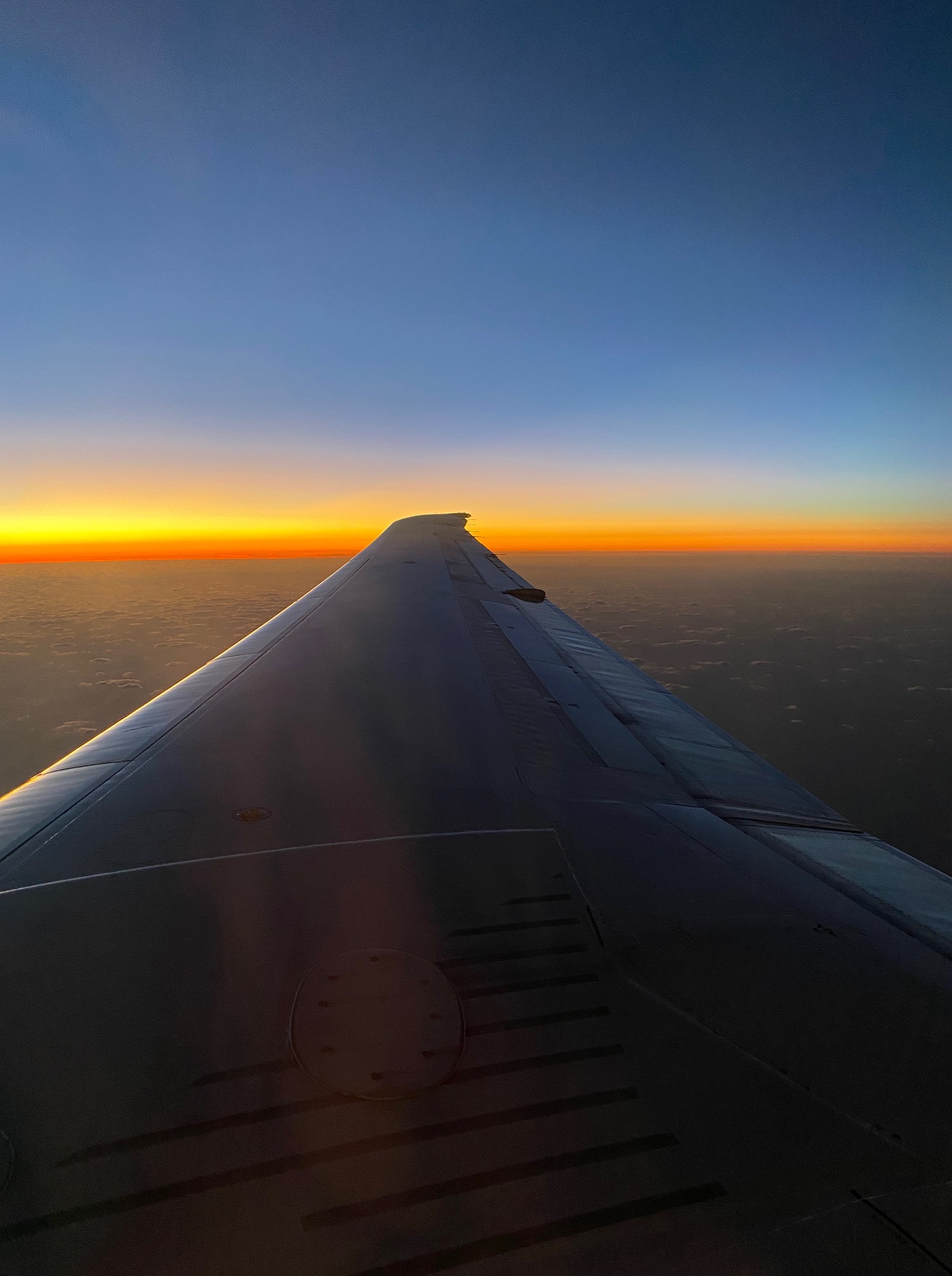
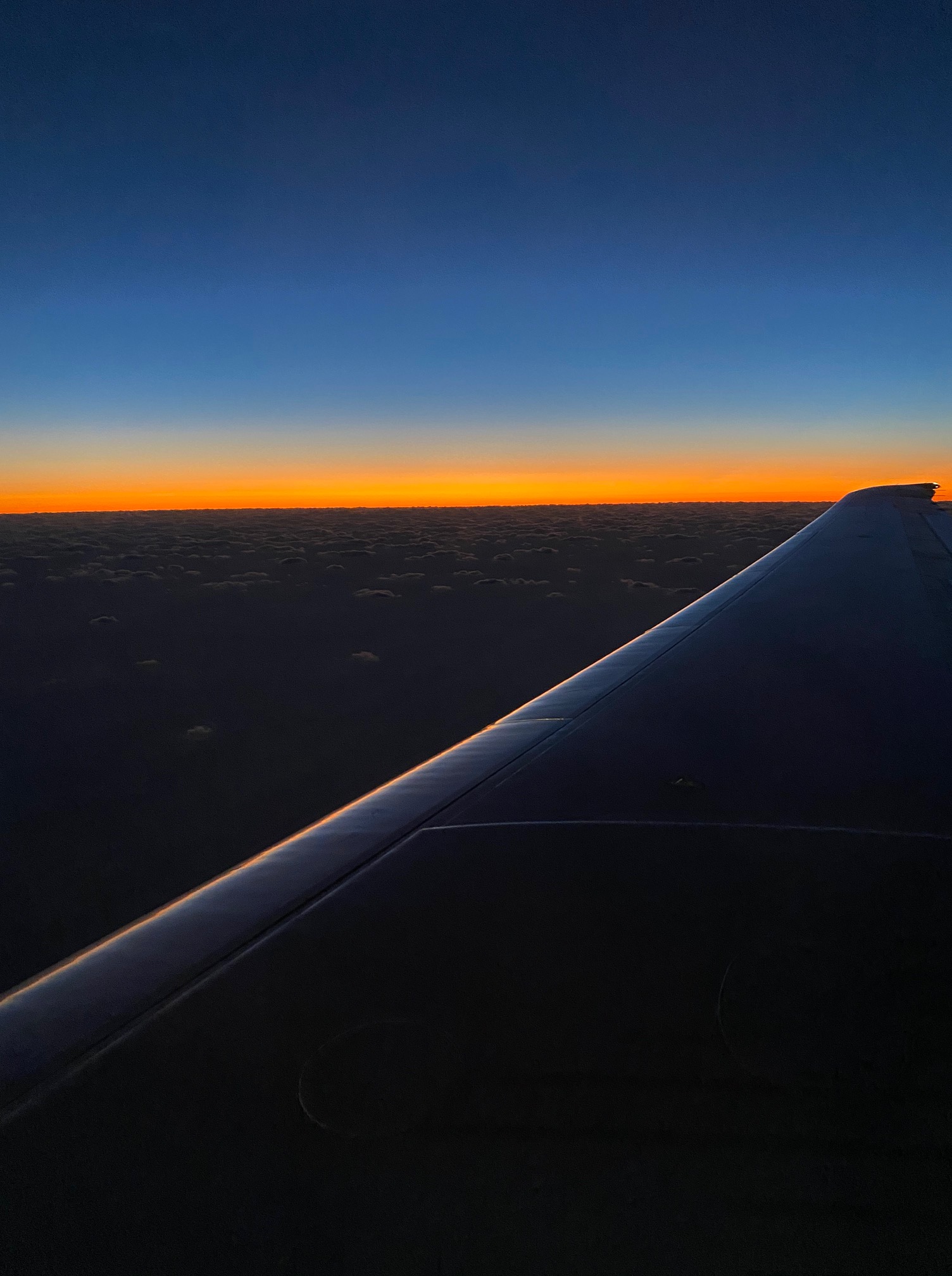
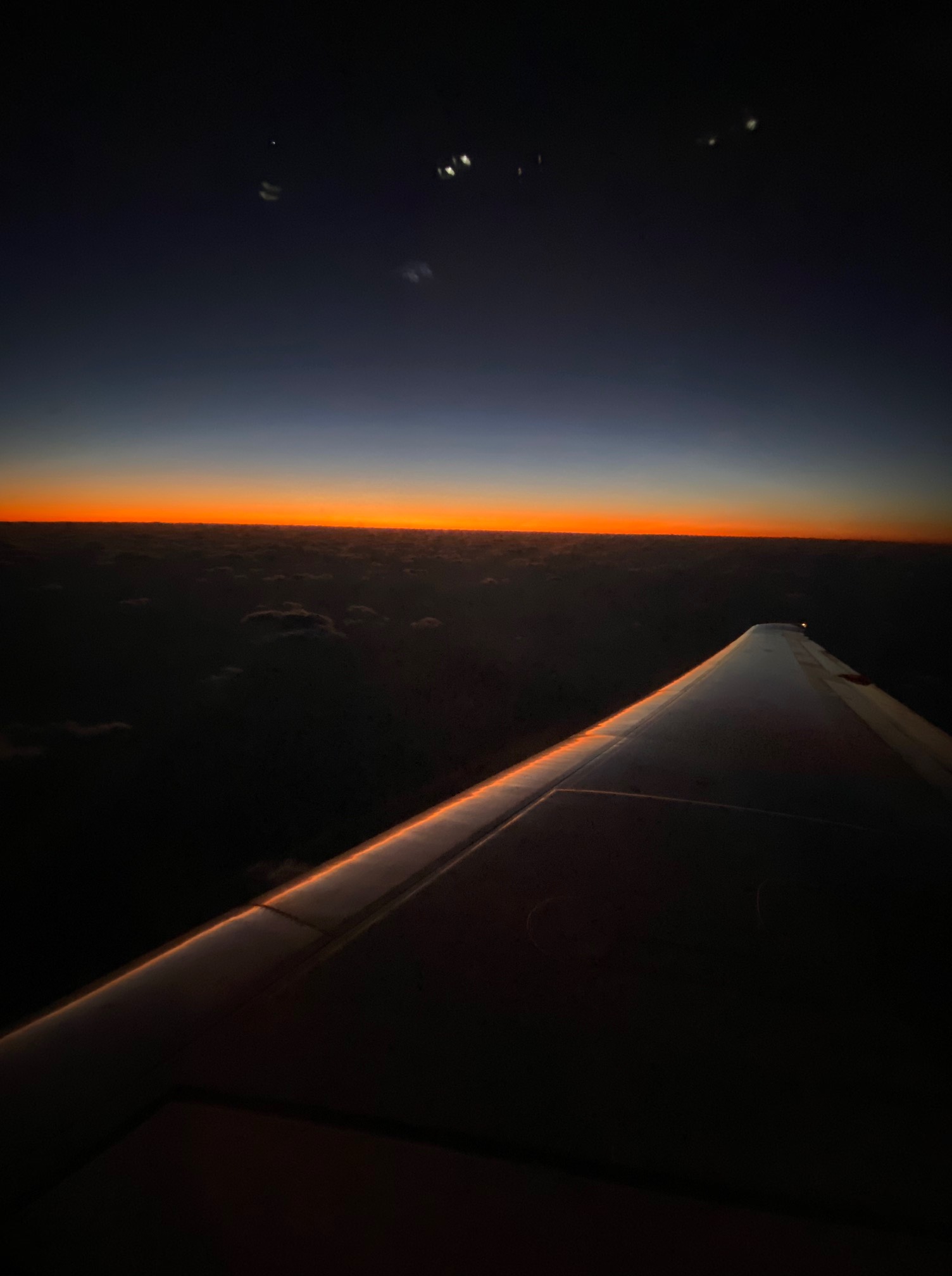
For me, personally, being required to write in a writer’s notebook is a little serendipitous, as I prepare to write my first big research paper based off of my own research. When I took the writing course as a part of my special education degree my sophomore year, I felt vastly out of my league, as I hadn’t been writing and had flat out never written anything like it before. Now, not only am I more experienced, but the writing time that I am gaining in this class is only helping me towards my comfort in writing in general. It has been such a wonderful experience to write for my own enjoyment for the first time in an incredibly long time. After reading the first section of “Textbook Amy Krouse Rosenthal”, I have found myself looking for moments of serendipity within my own life to fill my writer’s notebook with. I think that sometimes, it’s hard for us to slow down and notice the little things in life that make it seem like the universe is falling together in the right way. Reading what Rosenthal had to say on the subject of serendipity has definitely encouraged me to attempt to slow down some and notice the wonderful things that everyday life has to offer. For example, on my flight yesterday, we took of from Atlanta right as the sun had begun to set and landed right as it had finished. I was assigned to an aisle seat in an exit row (more space!!) and I got to watch the sun set through the window for the entire flight (see pictures below).

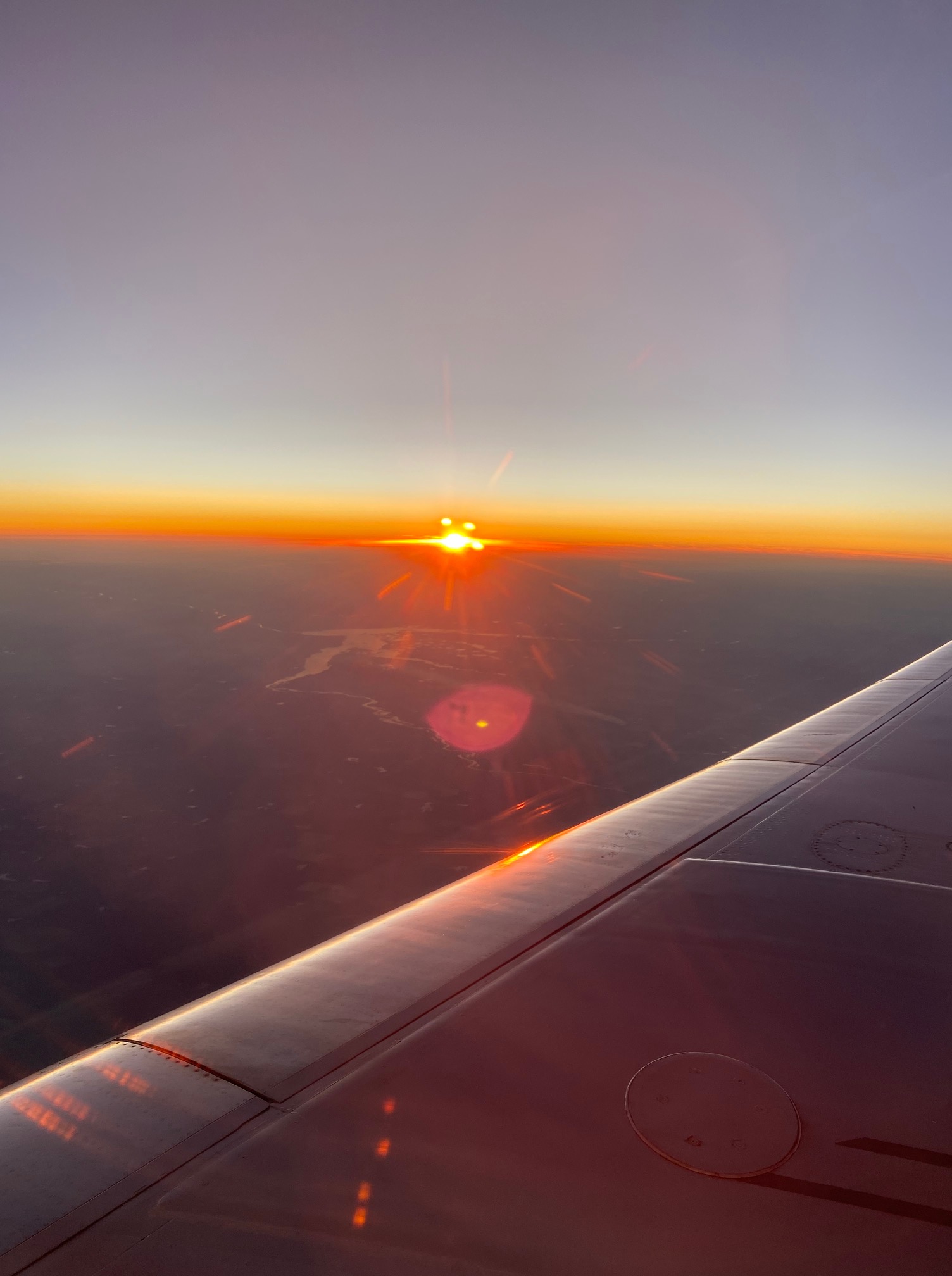
Rosenthal says in her book, “If you like something, you tend to be on the lookout for it. And if you’re on the lookout for it, you tend to find it, or it- Yoo-hoo! Over here!- finds you. And so it goes, for me, with serendipity and coincidence. It’s something I like, so it’s something I notice and attract” (Rosenthal, p 26). I think serendipity and enjoying the little things in life is something that I will put a more conscience effort in for in the future.

Dorfman, L. R., Cappelli, R., & Hoyt, L. (2017). Mentor texts: teaching writing through childrens literature, k-6(Vol. 2). Portland, ME: Stenhouse Publishers.

Rosenthal, A. K. (2016). Textbook Amy Krouse Rosenthal. Penguin Group USA.
My Experiences with Poetry

I’ll admit, my experiences with poetry this semester are probably a little different than what they would have been had we been in class in person, but that’s to be expected. However, I think that there have been certain things that I actually think that have been incredibly rewarding about it that I don’t think we would have gotten had we been in class. Mainly, being a part of the Literacy Casts have allowed us to see some really fantastic modeling on how to teach online. Never in a million years did we ever imagine that we would be in a position like this. Now, it’s looking like this could become a part of our reality in the future, so having the opportunity to experience how to teach poetry in an online setting has been priceless. In addition, having somebody like Adrian Rice come on and interact with the kids was so unique. There is something special about the creditability that a “real” poet brings as opposed to traditional teachers and seeing the kids, and even the teachers from the Academy and my fellow Graduate students, responded to him differently. The authenticity that he automatically brings is really lovely to see.

As for my other experiences with poetry this semester, I’ve really enjoyed the opportunities to explore all sorts of different types of poetry, as well as the chances to model poems after other poems. When you look at poetry from a teaching perspective as opposed to a learning about it as a student or enjoying it as a reader. I still enjoy doing those things, but I’ve really come to enjoy all of the things you can do when you’re teaching poetry as well. Particularly all of the different devices that I sometimes forget even have names that the kids on the Literacy Casts get so excited about pointing out get me excited to use some of the strategies to get my future students excited as well.

Perhaps my favorite part of all of the different poetry things I’ve learned about this semester would be my newest favorite poet that provides my newest favorite resource, Amy Ludwig Vanderwater and her Poetry Farm. From the first poem Dr. Frye showed us right in the beginning of the semester I was hooked, and the fact that I can go onto her website (http://www.poemfarm.amylv.com) and find not only new poems often, but writer’s notebook ideas and potential lesson ideas make it an invaluable resource for a future classroom.

Overall, being able to set aside time to sit down with some poetry this semester has been a really nice thing to be able to do. From being introduced to new poets to being taught how to teach different aspects of poetry, the lessons I’ve learned these past few weeks are going to carry over into whatever classroom I end up in next year.

Thank you so much for everything Dr. Frye. I can’t imagine what the last year would have been like without you. You have worked tirelessly to make this transition into online learning as seamless as possible and I know how much we all appreciate that. What we have learned will carry all of us far in our careers.

Poetry Reflection

I love poetry. When I was younger, I would write poetry every day at recess, trying and revising each poem until I thought it was perfect. Although I don’t do it often anymore, writing and reading poetry is something that I enjoy immensely. I didn’t do as much of it in high school because the only time that I really interacted with poetry was when I was analyzing it for a test. As a teacher, it is important to me that I can introduce poetry into my classroom. However, as a special education teacher, I know that introducing it in the traditional way is something that may or may not have the desired impact, so making sure that the introduction is something meaningful to the students is important.

It was actually from Dr. Koppenhaver’s class, but one good way to introduce poetry to students who may have difficulty with conceptualizing what poetry is and what is involved in writing it. One way that he suggested is by using observational poetry, by providing the students with an object or place or experience that they can write about in that moment and then using their senses to describe what they’re experiencing. I have never actually taught poetry before, so I wouldn’t say that I am comfortable at all with teaching it.

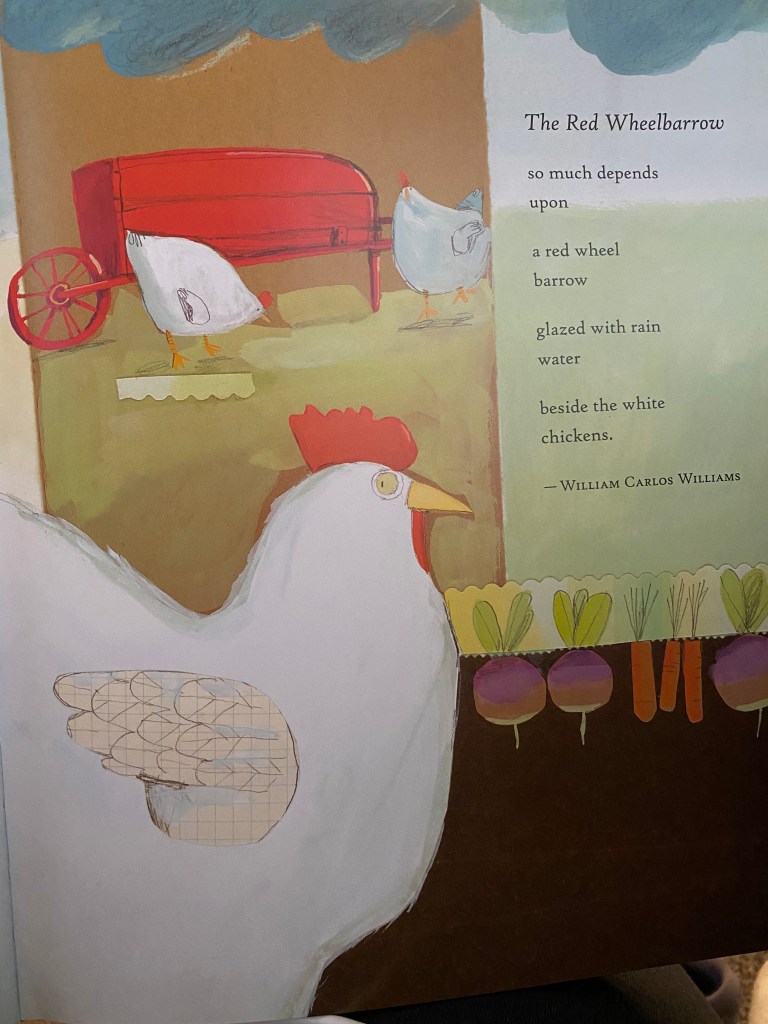
For me, there isn’t necessarily a specific set of criteria that lets me know that a poem is a good one. In my opinion, if a poem is able to elicit emotion and make the reader feel something, then the poem is successful. A truly exceptional poem is one that I keep coming back to, one that I purposely save and want to look at over and over again. One example of that for me is “The Red Wheelbarrow” by William Carlos Williams. At first glance, this poem, in no way, should be one that should be considered with any type of regard. Without any context, it almost seems like a kid who didn’t want to write their poetry assignment. However, upon deeper research, you find that the meaning of the poem isn’t what meets the eye. It is such a stark contrast from what poetry is traditionally, and initially, I believed it to be a satirical poem. In actuality, it is rumored that Williams, who was a doctor, looked outside a patient’s window and saw this scene, and something about it moved him. The imagery is so simplistic that everyone who reads it has their own vision of what this wheelbarrow looks like. What I love most about it is that it shows that poetry doesn’t need to be complex in order to make a poem meaningful.

I think that the best way to create a “poetry” environment in my classroom is to just have poetry available for students to read and to regularly model how to write different types of poems during writing time. From a young age, we want to make sure that poetry isn’t seen as something super complicated and intimidating, but just another form of writing that is a part of what we do in our class.

After Readings

Well, the first thing that stood out to me was something quite serendipitous….

Illustration by Melissa Sweet

My favorite poem! What I loved about both “Firefly July” with poems selected by Paul B. Janeczko and “All the Small Poems” written by Valerie Worth is that they both highlight poems that are short and simple. And not in a bad way, but in an attainable way, one that makes sense to a lot of people. You can read into the poems as little or as much as you want to. For students who are inexperienced in poetry, it’s so important to put them in poetry that is easy for them to access. The one thing that then stood out to me in “Awakening the Heart” are the three layers of reading poetry:

  • Choose poems to read that are immediately accessible, nonthreatening, and relevant to students’ lives- encourage reading projects that will invite all students into the world of poetry.
  • Help students connect personally to a poem by guiding them toward finding themselves and their lives inside a poem.
  • Guide a student towards analyzing the craft of a poem, figuring out how a poem in built, interpreting what a poem means, or unlocking the puzzle of a difficult poem

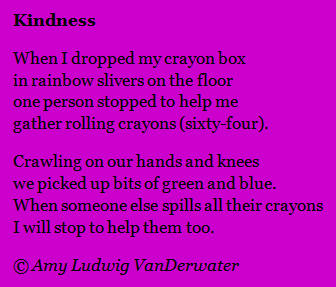
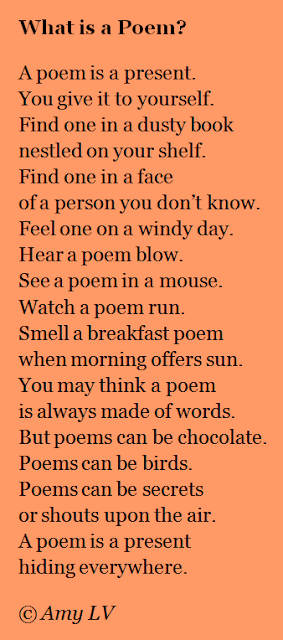
When I think about introducing poetry to students, my first thought is the accessibility because for so many young students, poetry can be entirely inaccessible. As I stated above, the poems featured in “Firefly July” and “All the Small Poems” are super accessible for kids of any age. Another great resource is Amy Krouse Rosenthal’s Poetry Farm, which I’ll link below. It’s where I found the poem at the top of the page and it is absolutely AMAZING. I love the fact that you can search by subject of the poem, which makes it a really neat tool if you’re trying to find a certain poem that might hit on a certain kid’s interests. For example, if some kids are really into science, she has a whole section on just science poems. It also allows you to find really specific mentor poems. If you’re focusing on one type/structure of a poem, you can search for that or if you want to focus on a certain aspect of poems, like emotion, you can find a list of poems that exhibit that trait. All of her poems (from what I have been through so far) are fairly accessible both in language and in content, so as a teacher, it can become an extremely useful tool.

Heard, Georgia. Awakening the Heart: Exploring Poetry in Elementary and Middle School. Heinemann, 1999.

Janeczko, Paul B. Firefly July: a Year of Very Short Poems. CANDLEWICK Press, 2018.

Worth, Valerie, and Natalie Babbitt. All the Small Poems. Farrar, Strauss and Giroux, 1991.

LV, Amy. “The Poem Farm.” The Poem Farm, 1 Jan. 1970, http://www.poemfarm.amylv.com/.

How to Grow a Narrative

This blog was nearly impossible to title, as I felt like I had so many different things I wanted to cover in very little time. I suppose I’ll do this in sections then.

Six-Word Memoirs

I have been familiar with six-word memoirs for a while. Admittedly, I don’t necessarily remember when I first read Ernest Hemingway’s famous six-word story “For Sale: baby shoes, never worn”. Nevertheless, I have always found it so powerful, because of the power that each individual word has to hold. When working on narrative writing with students, six-word memoirs can be a great activity to learn how to be descriptive and intentional with what they write. When thinking about what my six-word memoir would be, I had to think really hard about what mine might be. I went through a couple of different drafts before I landed on what I thought was the best representation of me in six words. This is what I landed on:

Leg shakes, eyes wonder, mind drifts.

Colleen McIndoe (aka ME!)

I decided on this because lately, my ability to stay focused has been something I have struggled with. When I thought about what I have experienced lately and my experience writing this memoir, this is what I came to. I think when we work with students, we can use activities like this to show students that sometimes we have trouble doing things as well and that we can use things that we struggle with to inspire our writing.

You-Do Lesson/Adding on to my Personal Narrative

https://docs.google.com/document/d/1eRNXi0DPbY7lTmxOtqi8Z3zPI4737nQeBmhbBkkHrVs/edit?usp=sharing

Linked above is our You-Do lesson.

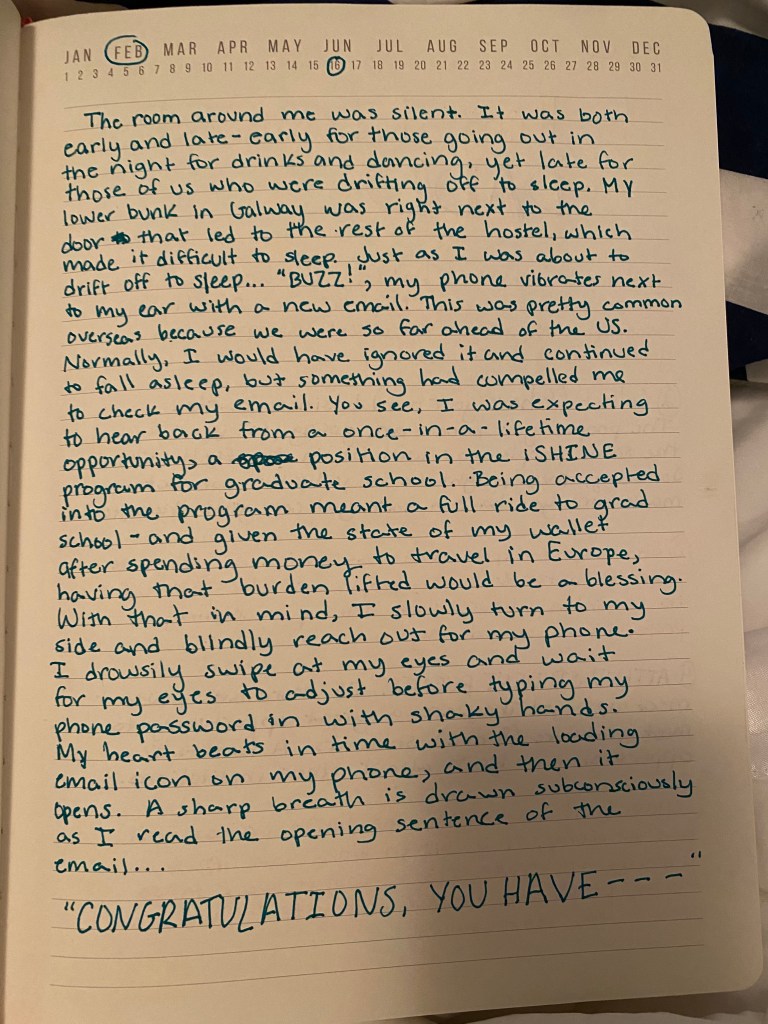
When I was looking at my original small moment narrative, I decided that I wasn’t a huge fan of it, so I decided to restart it entirely. When I rewrote it, I decided to look at the lessons from Chapter 4 of “Mentor Texts” and for my narrative in particular, I thought that the “Building Content Through Showing, Not Telling” was a natural fit. In my original version of the narrative, I used quite a bit of telling because there was explanation that was necessary to build up the background of why the narrative is important to me. I thought that adding more descriptive elements would not only assist me in adding additional detail, but that it would also allow me to lengthen what I already had. So I started with this as my first draft:

First Draft in my Writer’s Notebook

This is what I got from my second draft that focuses on Showing, Not Telling:

Silence enveloped the room, as bodies filed in and out of the door to the lobby.  It was both early and late- early for those headed out to see the nightlife in Galway and late for those who were retiring after a long day of exploring the city.  I found myself in the latter, having spent the day traveling the emerald green coasts of Ireland, leading to the spectacular view from the Cliffs of Moher. Freshly showered and half asleep on the bottom bunk, the only light that illuminated the room was the strip of light from the bottom of the bathroom door, at least that was the case until… “BUZZZZ”, my phone laying next to my head vibrated to life and lit up the inside of my eyelids.  Normally, I would ignore it, put my phone on Nighttime mode and continue falling asleep. However, In my semi-conscious state, I remembered that I was waiting to hear from Appalachian regarding my application for the iSHINE program, which would provide me with a full scholarship to graduate school and an opportunity to participate in research in something that I was really excited for. Bleary eyed, I reach around for my phone and my heart thumps out of my chest as I open up my email to see an email that begins “CONGRATULATIONS- You have been chosen…”.  A small squeak escapes my throat as I run out the door barefoot to call my parents, nevermind the fact that the floors were disgusting. After a brief conversation with my parents, I go back to get in my room and I am met with a locked door. In my excitement, I had managed to forget my room key, which would allow me to get back into the dorm because the doors automatically lock when they close. After a few tries opening the door and knocking a few times, I walk out to the help desk, a little closer to the ground after floating on Cloud 9, and sheepishly request to be let back into my room.  A shiver travels down my spine at the cool air next to the front door, my shorts and t-shirt doing little to block out the breeze that escaped between the gaps of the sliding doors.

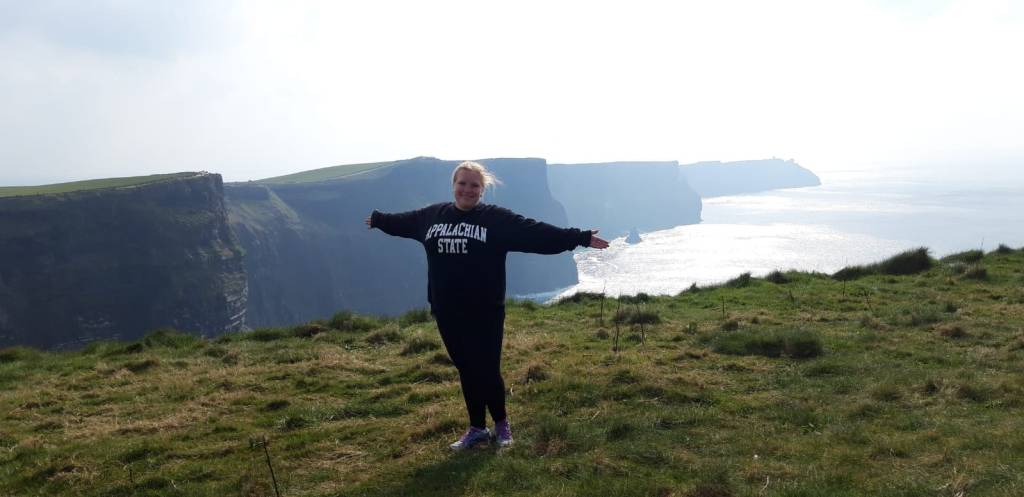
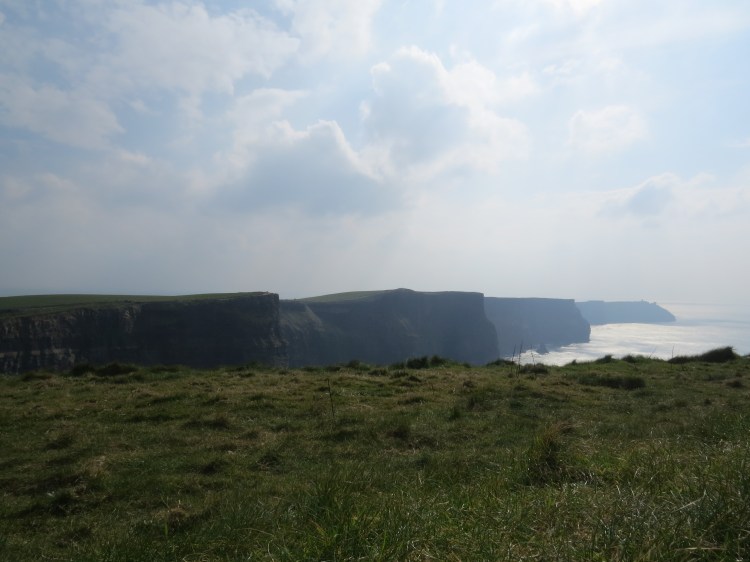
I don’t have a picture from the hostel, but this is a picture from earlier that day.

Mentor Texts

I continue to look towards mentor texts that I have experienced in my life that have helped me to become the writer that I am today. Everything in class has caused me to start wondering what I would consider my “mentor texts” to be when I’m writing and I’m struggling to find even a short-list of authors I aspire to write like. Recently, Amy Krouse Rosenthal (her humor and attitude is something I someday want to embody) has become one of my all time favorites, but I have struggled to think of others and that’s when I figured something out. When I was younger, I read a lot and would read pretty much anything I could get my hands on. The problem is that there are very few books from that formative period that stood out individually to me, so what I have come to discover is that my writing is a product of everything that I’ve read and that the things that I read today shape how I write tomorrow. Right now, I have “Thinking in Pictures” by Temple Grandin in mind while I wrote. I enjoy her writing immensely and is incredibly informative.

In Calkin’s “Revising Leads”, I loved how she had the example of how a student wrote before and after having read books from their classroom library. Reading is such a powerful tool when developing writers. If young writers don’t read works from good authors, it’s hard for them to improve, because they don’t know what really good writing looks like. We have to be very intentional when introducing students to new books and when providing them with good mentor texts that can help them to find their own voices.

Calkins L.M. (2006) A guide to the writing workshop, grades 3-5. Portsmouth, NH: Heinemann

Dorfman, L. R., Cappelli, R., & Hoyt, L. (2017). Mentor texts: teaching writing through childrens literature, k-6(Vol. 2). Portland, ME: Stenhouse Publishers.

Rosenthal, A. K. (2016). Textbook Amy Krouse Rosenthal. Penguin Group USA.
Why Focus is Vital

This week, we learned about focus and why that is important when we’re writing narratives. When teaching students how to write personal narratives, it’s important that we are teaching students how to focus in and write about small moments. For so many kids, it’s hard to dive into detail and to use their senses to describe their small moment. For students, we’re going to work on finding things to write about and how we can take those writing territories and narrow them down to small moments that can become personal narratives.

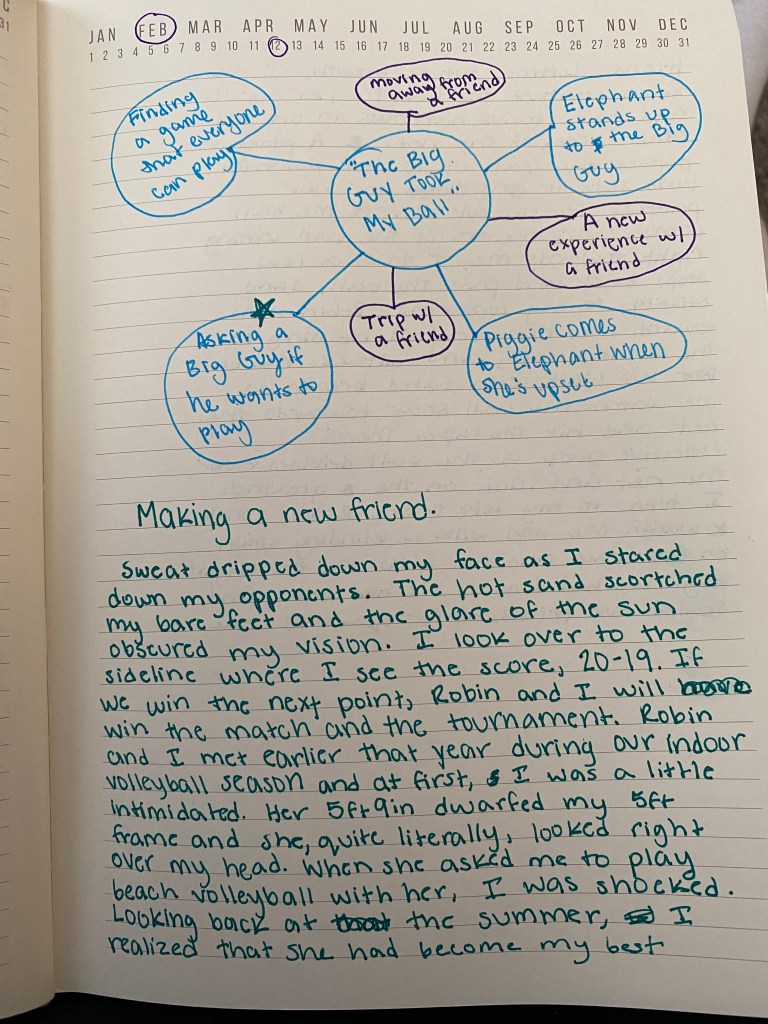
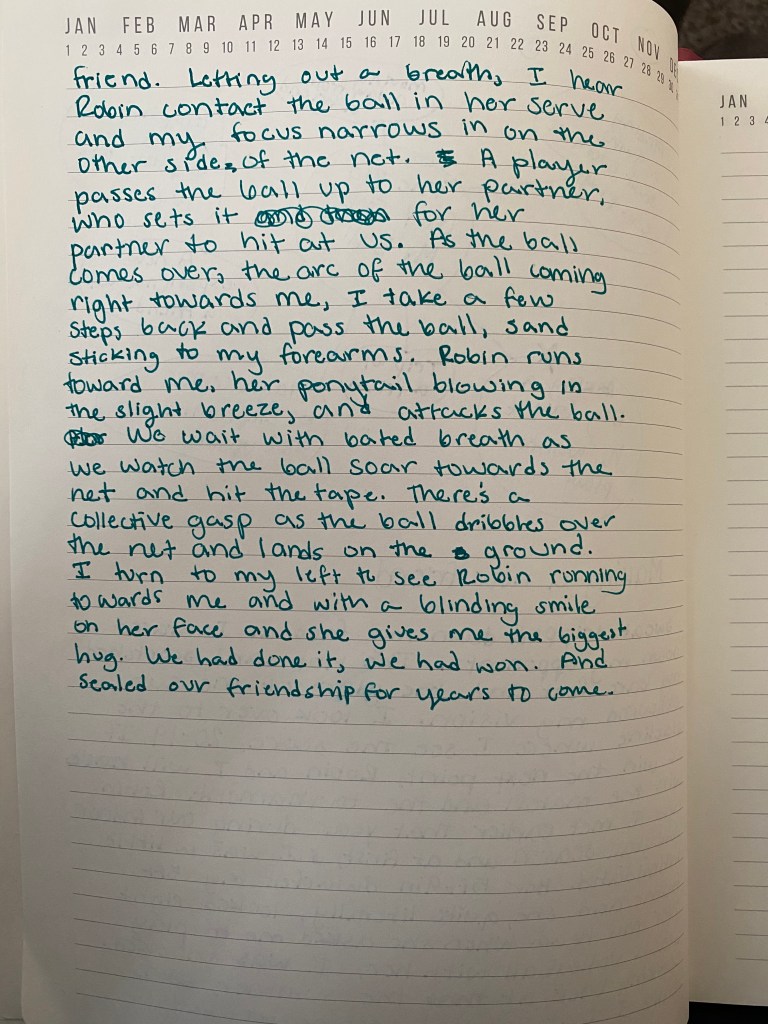
I looked at the “Finding the Point of Your Story” lesson from “Mentor Texts” to guide my narrative. Personally, I was trying to do this with one book, so I didn’t get to do this fully, but I enjoyed the strategy because I got to look at the experiences Piggie and Elephant from “A Big Guy Took My Ball” and see how they related to my experiences and how I could use them as ideas to spark my own writing. I have attached a copy of a draft of the lesson we wrote and a draft of my writing.

Your Turn Lesson 1 https://docs.google.com/document/d/1TvYvWU0vfk5MMv9U8f75292IFxwRSkfmy3ZDeaMJl_I/edit?usp=sharing

Looking at my work, I know that it isn’t my strongest work, but I think that our students will face that too. It was really easy for me to become discouraged that my writing wasn’t coming out the way that I had wanted it to and as teachers, we need to be prepared for when our students will go through phases like this. Part of what I told myself was that I just needed to get something on paper. It didn’t have to be any particular length and it didn’t have to be perfect, but I needed to get something out. With that thought process, I churned out this incredibly rough draft of a personal narrative, using the strategy from “Mentor Texts”.

This week, we also read “Happy Like Soccer”, which was a beautiful narrative story and one that I think that so many kids will be able to relate to. It doesn’t narrow into a “small moment” in the typical definition, but it does relay an experience and a full story of feelings within it. Emotion is so important when writing a narrative and I think that is what the students will get the most of out of this “mentor text”. The range of emotions that both our protagonist and her aunt go through during the book help the story become relatable and can show students (in a more explicit way), how emotions can help move stories forward. And that all stories have emotion because we, as humans, have emotions and they are a part of what makes a story entertaining. And any experience a child has that causes them to feel different things can become a story, as was shown in the “Why Narrative Writing Matters” article. Not every child will have some wild, exciting experience to write about, but every child has a story to tell and having students tap into the emotions of a moment helps them to relay that story to the fullest extent possible.

After looking at my small moment narrative, I think I will probably rewrite it about something different because I don’t think that this will be the best thing to write about for me. And I think that students will go through this too, so modeling that process for them is important as well.

We also talk a lot about writing territories, which are different areas that we have that we could write about. The writing territory that we are exploring in this practice is friendship and different aspects of friendships. Students can pick out different experiences that they can write about in regards to their own friendships. It’s important to show them that we can all read the same thing, but that there are so many ideas that can come from it. And even if we’re writing about something like “making a new friend”, what the students will come up with will be a wide range.

What are we supposed to write about?!

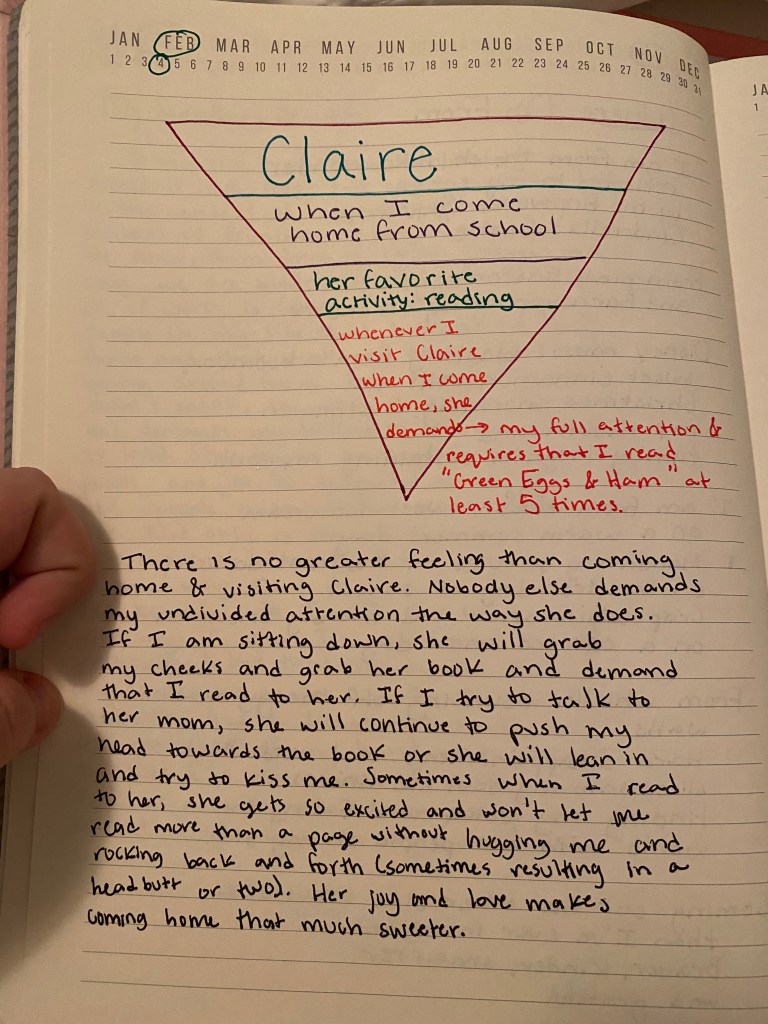
When students are first starting on writing in a writer’s notebook, one of the biggest struggles that they face is finding what they are supposed to write about. As teachers, we don’t want to tell students what to write, but we do need to give students the tools that they need to choose their own topics and to motivate them to write. I decided that I would try one of those strategies myself, as shown below. In “Mentor Texts”, Dorfman & Cappelli discussed writing territories and how to narrow those territories down into specific topics. Territories can be people, activities, prompts, pets, and so many other things. Anything you can write a lot about can become a territory. Once you pick a territory, it’s important to narrow that down to a specific topics. One strategy that is modeled in “Mentor Texts” is using an upside down triangle to help the students narrow in on a singular topic. When I wrote mine, I decided the territory I wanted to write about was Claire, a girl that I care for at home. As I narrowed my topic down, I wanted to focus on when I get to come home and surprise her because that is always an exciting time for us. In particular, whenever I surprise her, she demands my attention and that we read together. Those memories are really special to me, so I knew that I wanted to write about that in my notebook.

My writing based off of the strategy described in “Mentor Texts”

In the piece “Launching the Writer’s Notebook” from Calkins, she describes a very similar strategy , describing how she had her students pick important people in their lives, have them write down a few memories of that person and then having them pick a memory to write about. In the article, she shows us how she modeled it for her students. I found that this was just a different way to structure what Dorfman & Cappelli described in Mentor Texts. The way that they use the strategy is in a more visual way than how Calkins by using that graphic organizer. I really like the upside down triangle because you can visually see how you are narrowing down what you’re going to write about. I can see something like that being used in my future classroom quite easily. Anything I can use to support writing in a visual way is going to be valuable to students with more significant needs.

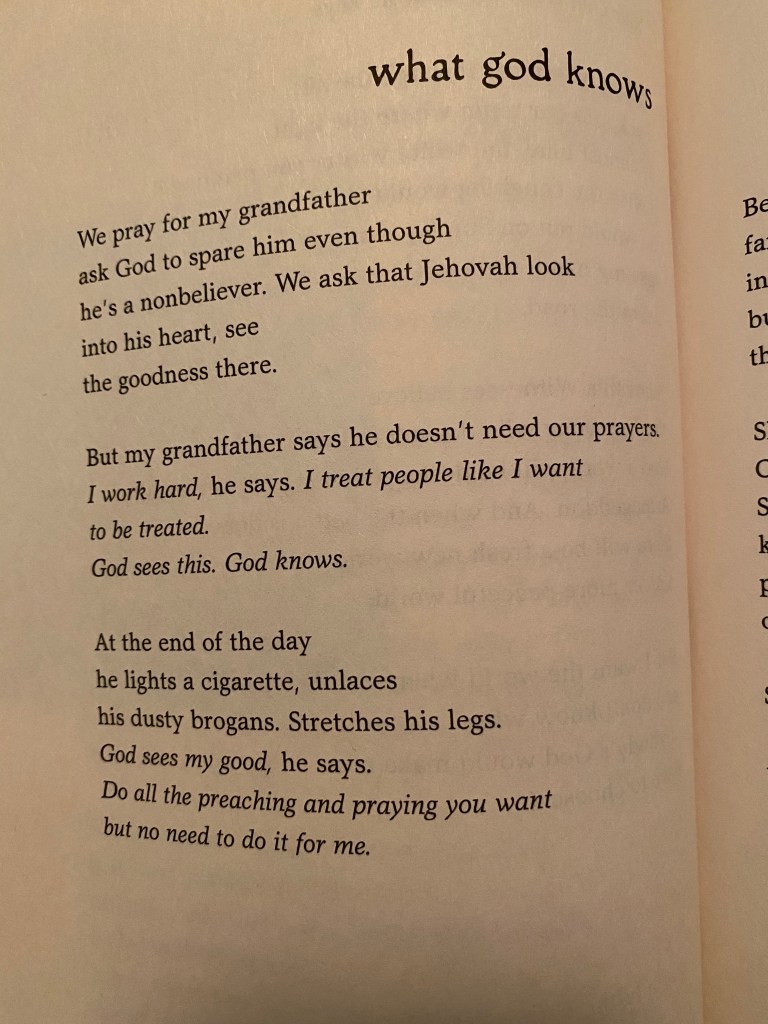
In addition to learning how to help students generate ideas for their writing, we also took a look at a few different “mentor” texts in the forms of “Textbook Amy Krouse Rosenthal” and “Brown Girl Dreaming”. In “Brown Girl Dreaming”, I found a few poems that I thought would really lend themselves to being mentor texts for students. One in particular called “what god knows” could really inspire some introspection and really thoughtful writing. Of all the poems in “Brown Girls Dreaming”, this one really made me pause and think about what I believe and how that relates to what other people believe. For older students, middle schoolers in particular, discovering who they are in relation to the people around them and I know when I was that age, I was really motivated to write about what I believed in and what that meant to me. I look forward to exploring that further even as a 23 year old in my writer’s notebook.

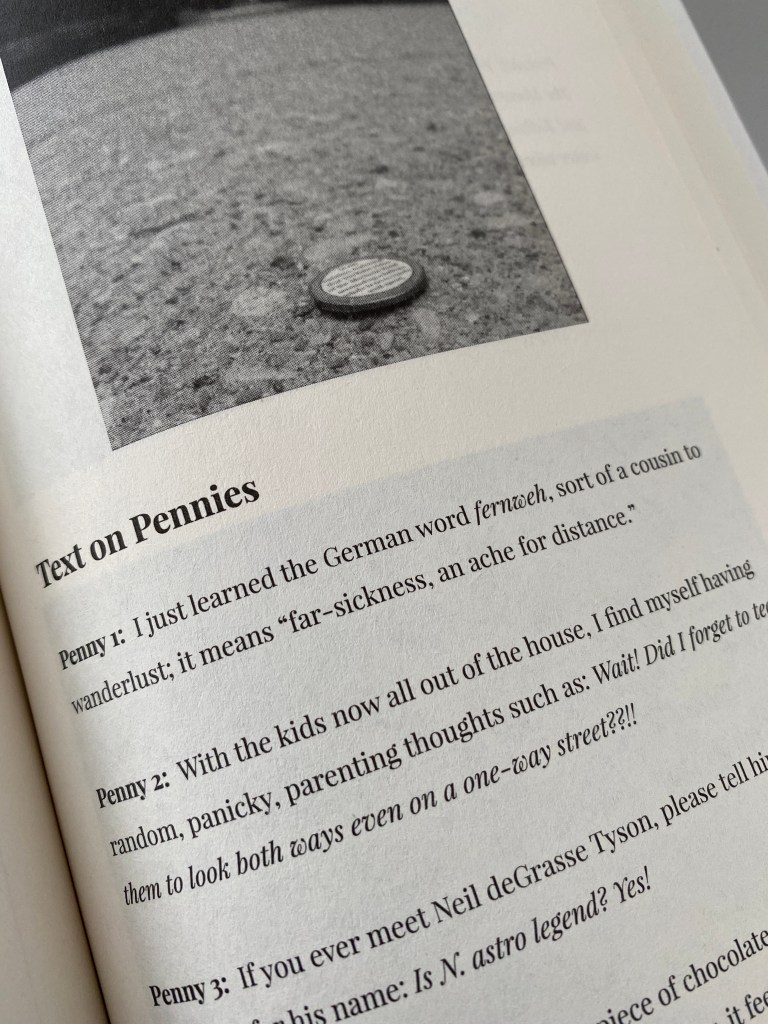
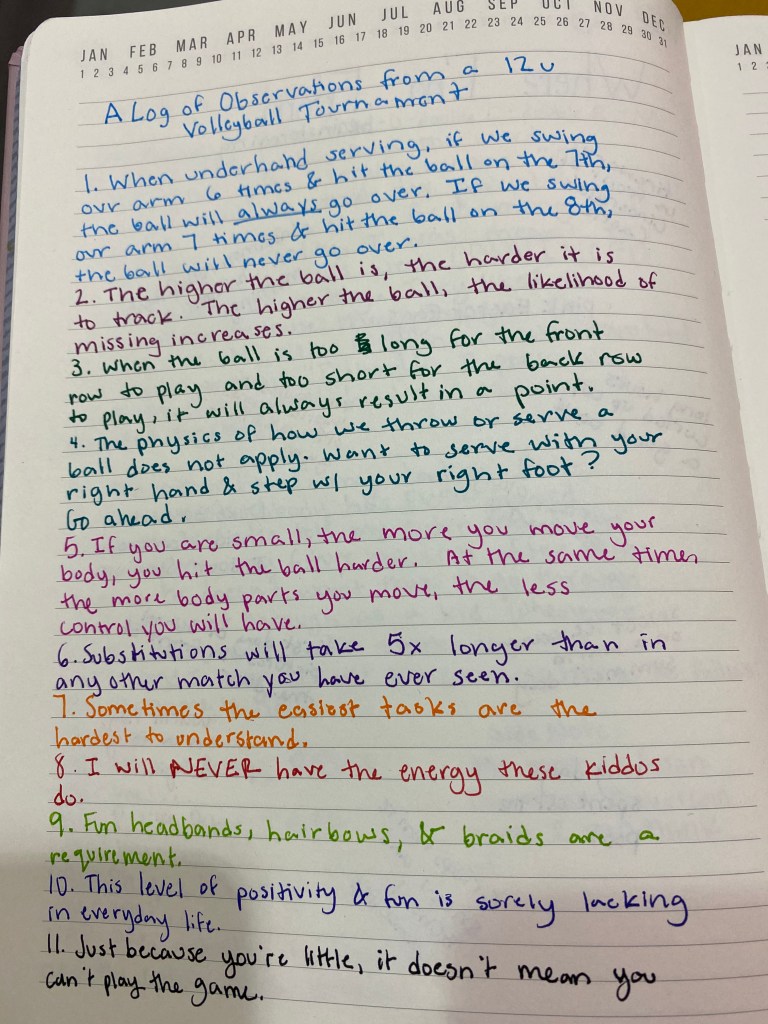
I swear, “Textbook Amy Krouse Rosenthal” is becoming one of my favorite books. In particular, her “A penny for your thoughts” exercise was particularly inspiring. I love writing down observations and thoughts that I have, as evidenced by one of the entries that I actually wrote before I even looked at TAKR this week. I referee volleyball and working with the 12 and under age group is always particularly entertaining. There ended up being more free time, so I decided that I would take that time to write down observations and lessons that I learned from the players. They did not disappoint to say the least. There were so many funny one-liners and even profound findings that I hadn’t anticipated. I think that keeping track of things that you learn and think about is a good way to remain present, as well as a way for you to remember things that you don’t want to forget.

Fun Fact: My roommate from freshman, sophomore and senior year was a double major in History Ed and German language and she had the travel bug in a big way. I actually made her a sign to go up in her classroom this year that said “fernweh”. I found this quite serendipitous.
Right before I posted this, I realized that today was “Girls and Women in Sports Day”… Another serendipitous moment.

Introducing students to both mentor texts and strategies that help them to generate ideas of their own are vitally important to create independent writers. Help them find what they’re passionate about, what they want to learn, how to observe the world around them. All of these things can lead to really deep, powerful writing moments, but it’s our job as teachers to help them get to the place where they can do that.

Dorfman, L. R., Cappelli, R., & Hoyt, L. (2017). Mentor texts: teaching writing through childrens literature, k-6(Vol. 2). Portland, ME: Stenhouse Publishers.

Woodson, J. (2014). Brown girl dreaming. New York: Puffin Books.

Rosenthal, A. K. (2016). Textbook Amy Krouse Rosenthal. Penguin Group USA.
Calkins, L. M. (2006). A guide to the writing workshop, grades 3-5. Portsmouth, NH: Heinemann

Writing, writing, and more writing!

I have written more in the past week than I have in a very long time (excluding writing papers because let’s be honest, this is far more fun). It’s been slightly hectic given that I spent half of this past week in Florida, but having the writing notebook has motivated me to take time every day and reflect on something that happened in my day. Never have I found a more rewarding school assignment, one that I believe that I will continue with far past the boundaries of this class. When reading “Mentor Texts”, one note stood out to me more than anything else. It states:

As students get older, writer’s notebooks become their treasure chests. They write about their observations, anecdotes, connections to literature, and discoveries about authors’ craft. They write the tiny stories that they record of the history of their lives

Dorfman & Cappelli, Chapter 2, Page 23
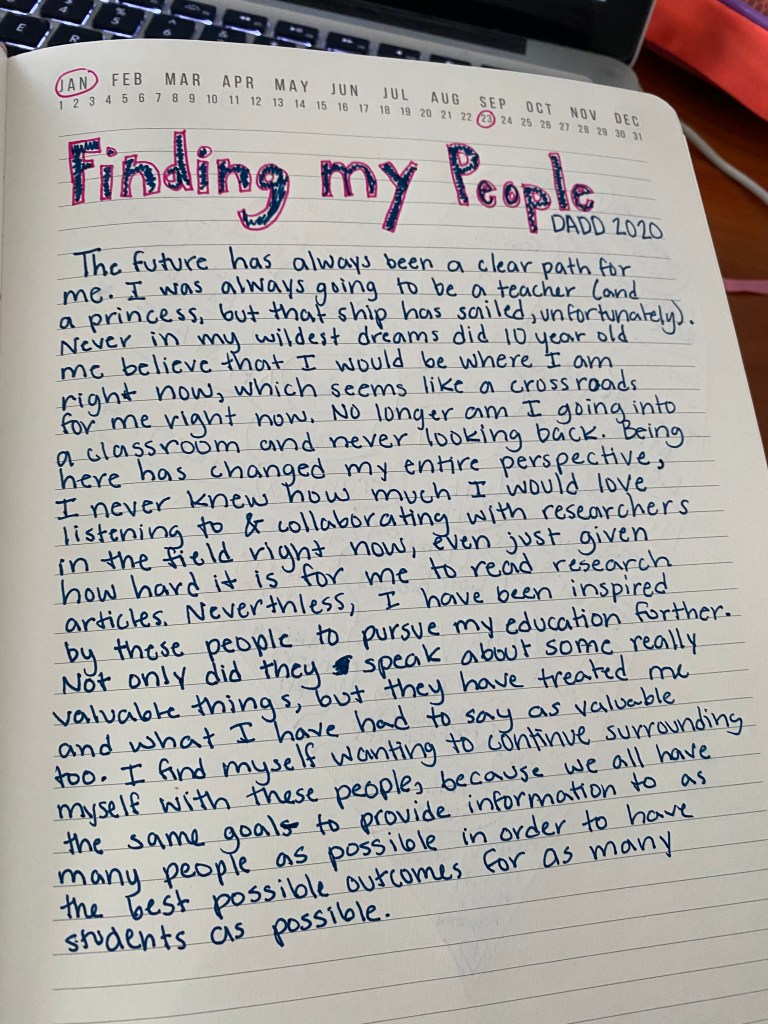
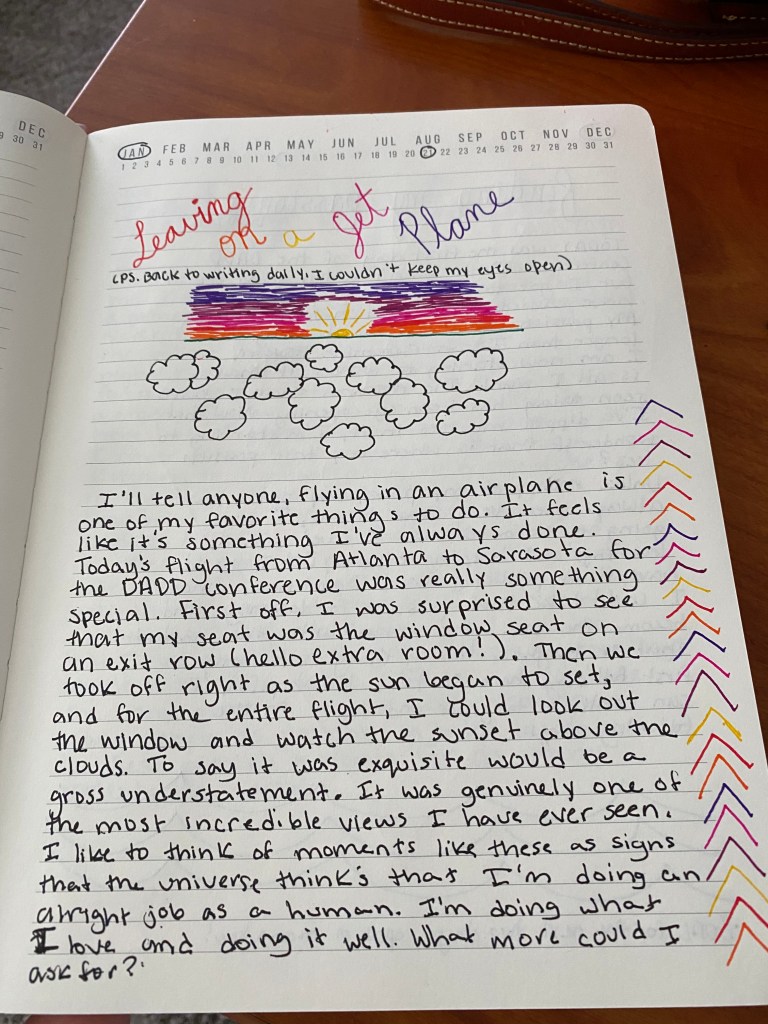
I wrote this entry in Florida when I was at the DADD conference. I wanted to make sure that I had memories of why I loved this experiences so much and how I can use it as motivation in the future to get back there.

That got me thinking a lot about not only the students I want to teach, but also myself. I can sometimes struggle with my memory, and having something that I can go back to that allows me to think back to what happened in a particular moment or on a particular day is really special. I want to teach student with significant disabilities, so giving them a space where they can reflect on what is going on in their lives is also really important. Some of these students don’t always have a way to have a ton of different traditionally “exciting” experiences, for medical or other reasons. Using the writers’ notebook as a catalyst for them to write about what is important to them and as something I can use to introduce them to new things and learning experiences is exciting. I look forward to implementing a writers’ notebook in my classroom in the future, so I can help my student’s to celebrate what happens in their lives, as well as to react to thing that they have learned. At the end of the year, it will be so rewarding when they can go back into their notebooks and see all that they have accomplished and experienced.

Kind of building off my previous thoughts, I’ve been thinking about ways that I can adapt a writers notebook experience for my children with significant disabilities. I’ve thought about having students keep an online journal filled with pictures of what they feel is important to them. In an ideal world, I would love to have each student have access to a camera or someone with a camera that they can instruct to take pictures of something to add to their notebook. Writing can be a tiring task for many with physical disabilities, so allowing them to gather these pictures of what they find important for them to come back to and write about later is a really neat idea. I can also open that up to parents to upload pictures of things that they have done on vacation, over a weekend, etc. so that the child has an abundance of different topics that they can write about, as well as a “memory book” of sorts that they can look back on in the future.

“Textbook Amy Krouse Rosenthal” continues to leave me struggling for breath from laughing so much. In particular, her “Resolutions of Bewilderments” (pg. 88) were so relatable and really made me pause to think about all of the different things that I have realized as I’ve gotten older. From little thing like why my parents didn’t let me bake cookies as much as I would have wanted to (I was a pretty messy kid and it might have been disastrous) to why TV’s were in black and white back when my parents were kids (I was 8 or 9 before I realized that it wasn’t because the world was black and white back then). Those are things that we never really think about, but those little bewilderments happen constantly. They have really inspired me to think more deeply on all of those “life” things that I’ve learned and are topics that I think would make great writers’ notebook topics in the future.

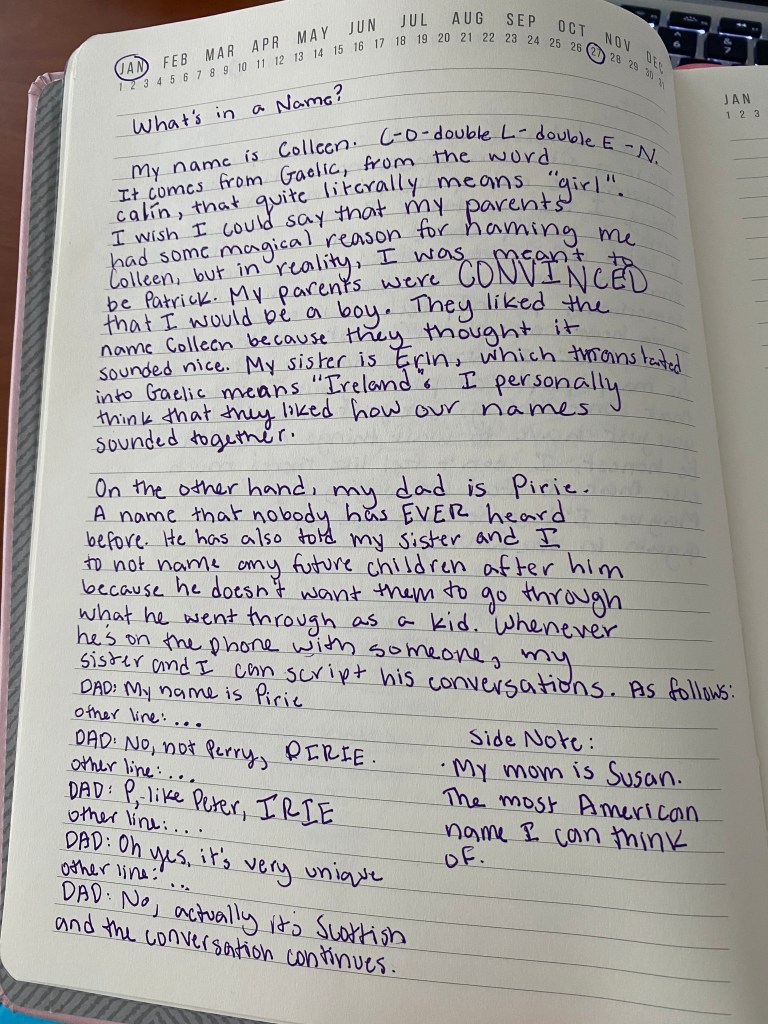
In “Brown Girl Dreaming”, I really connected with a few different moments within the book. One of the poems that stood out to me was, of course, the poem she wrote about her name, “A Girl Named Jack” (p. 6-7). As somebody with a unique name, and as someone who was “supposed” to be a boy, I felt Woodson’s words deep in my soul. As my journal entry below states, “I was an “almost” Patrick.” I’ll admit, I am incredibly grateful to not be a “Patty” or something along those lines. See my “What’s in A Name?” notebook entry below:

Towards the end of the book, she writes an “I Believe” poem, which I distinctly remember writing in either middle school or my freshman year in high school. Or maybe I have written more than one, I’m not entirely sure. It was really cool to see a familiar poem format and to see how she made it her own. In general, I think any way that we state our beliefs is extremely powerful, and the way she does it in her book is no different. Stylistically, I loved her choice to not start her poems with capital letters and only capitalizing proper nouns. Using the capitals as a way to create emphasis was really powerful to me.

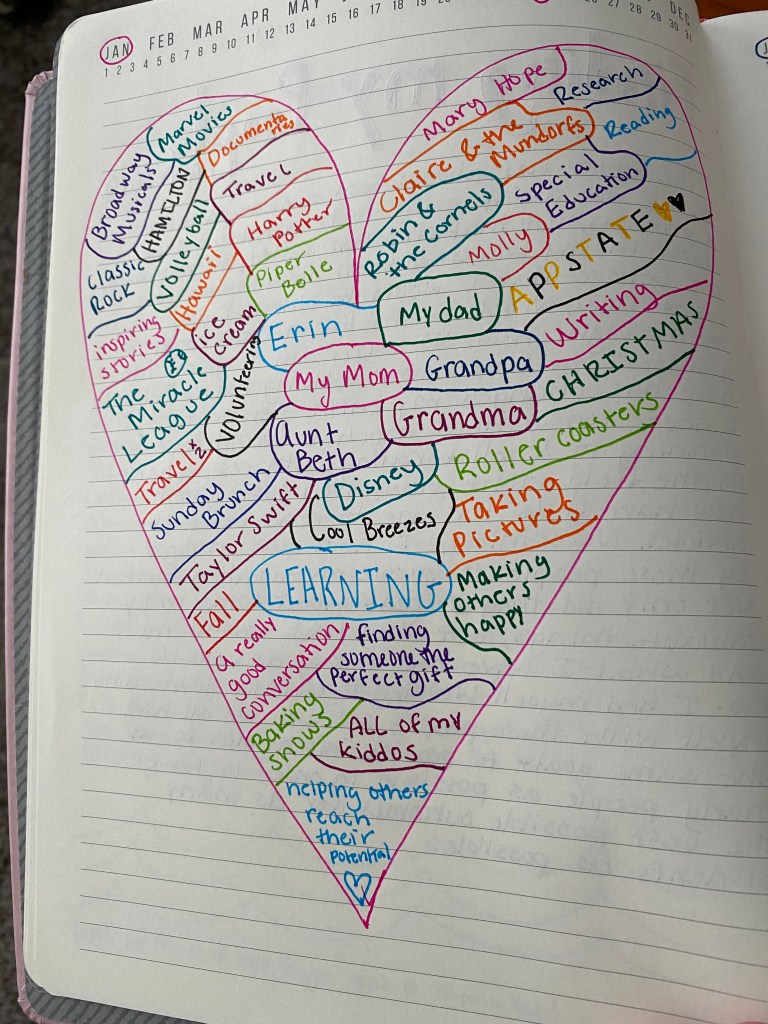
I have also included a few of my other favorite notebook entires so far, including my heart map, which I actually have another version of in a notebook that I have from the second grade. How wild is that? I don’t remember exactly where that notebook is, but I distinctly remember creating a heart map for Ms. Jacob’s class. Some of the contents have changed, but many have stayed the same, from my family to things like Disney and Harry Potter.

Dorfman, L. R., Cappelli, R., & Hoyt, L. (2017). Mentor texts: teaching writing through childrens literature, k-6(Vol. 2). Portland, ME: Stenhouse Publishers.

Woodson, J. (2014). Brown girl dreaming. New York: Puffin Books.

Rosenthal, A. K. (2016). Textbook Amy Krouse Rosenthal. Penguin Group USA.
Design a site like this with WordPress.com
Get started